
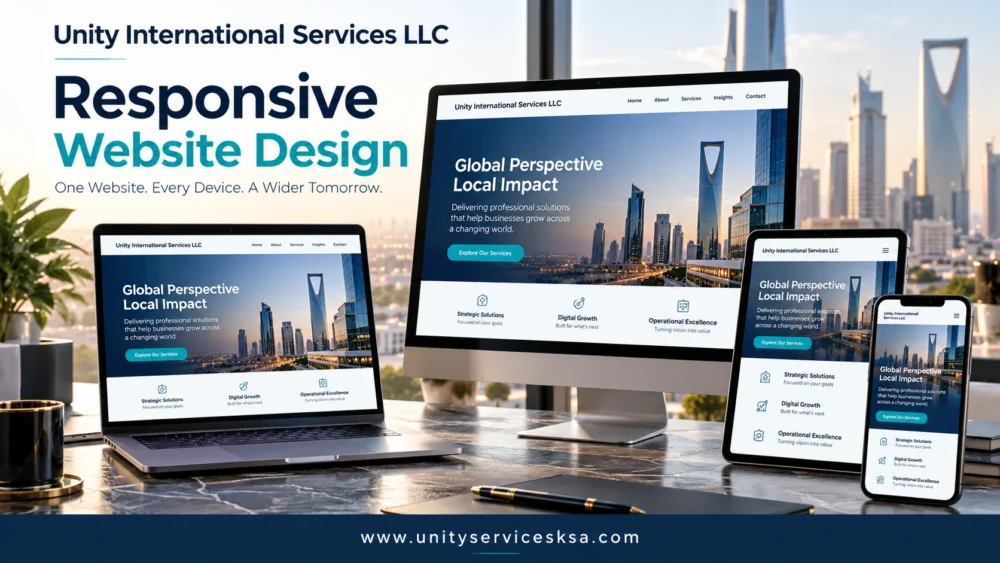
Choosing a web development company is a decision that affects how customers discover your business, understand your services and contact your team. A successful website needs professional design, practical functionality, clear content and dependable support.
For businesses searching for the best web development company in Saudi Arabia, Unity International Services LLC offers a starting point for discussing corporate websites, e-commerce platforms and business-focused digital projects. Its website lists corporate website development, online shops, landing pages, booking websites and industry-specific website categories. Unity International Services LLC
The right development partner should understand both your public-facing website and the business processes behind it. This article explores Unity’s service positioning, the connection with Trimatrik Multimedia in Bangladesh, relevant software projects and the qualities businesses should look for when planning a digital investment.
About Unity International Services LLC
Unity International Services LLC serves the Saudi market through a business portfolio that includes technology products and digital services. For website clients, the central opportunity is to create a professional online presence that supports practical business objectives.
A company website may need to generate enquiries, present a service portfolio, display products or help customers request appointments. A larger project may require customer accounts, administrative dashboards or connections with other business systems.
These requirements should shape the development plan from the beginning. Design, content and functionality work best when they support the same purpose.
For example, a construction company needs visitors to find its capabilities and projects easily. An online retailer needs customers to locate products and complete purchases. A service provider needs an enquiry process that collects useful information for the sales team.
Unity and Trimatrik Multimedia: The Bangladesh Connection
As described by the business owner, Unity International Services LLC and Bangladesh-based Trimatrik Multimedia share ownership. This connection brings the Saudi business offering together with the Bangladesh operation and its ongoing technology and software work.
The connection is relevant because developing a business platform involves more than writing code. Teams need to understand how employees manage information, how customers ask questions and how organizations handle changes after launch.
The Bangladesh project portfolio discussed by the business includes eHajira, focused on HR, attendance and payroll, and eBiddyaPro, focused on education management.
These projects provide concrete subjects for portfolio demonstrations. Prospective clients can review their workflows, interfaces and administration features to understand the team’s approach. For each new Unity project, delivery responsibilities, support arrangements and the contracting company should be defined clearly.
Why Businesses Should Consider Unity
The strongest reason to choose a development company is a good fit between its delivery approach and your requirements. Businesses evaluating Unity should consider the following areas.
Understanding the Business Before Designing
A website should begin with questions about customers, services, operations and commercial goals.
What do visitors need to know before contacting the company? Which enquiries are most valuable? What information should employees update themselves? Which tasks currently require repeated manual work?
A clear discovery process turns these answers into a sitemap, feature list and project scope. It also helps prevent unnecessary features from increasing cost and complexity.
Connecting Websites with Business Workflows
A website enquiry has value only when someone receives and follows up on it. An online order needs a practical process for stock checks, payment confirmation and fulfilment.
Projects should therefore consider the steps that happen after a visitor clicks a button. Where integrations are required, their technical scope and responsibilities need to be established explicitly.
Planning for Continued Use
A website should remain manageable after launch. Content updates, employee access, backups and technical maintenance all influence its long-term usefulness.
Buyers should ask how the website will be handed over, what documentation will be supplied and which ongoing services are included.
Corporate Website Design and Development
A corporate website presents the organization’s identity and gives customers a dependable destination for company information.
Its structure may include an introduction, company profile, services, projects, industries served, careers and contact details. The exact pages should reflect the business rather than a standard template alone.
Professional design helps visitors identify important information quickly. Consistent typography, suitable images, clear navigation and focused calls to action make the company easier to understand.
Content deserves equal attention. Service pages should explain what the business provides, who the service is suitable for and how a customer can begin an enquiry.
A content management system can allow authorized staff to maintain these pages, with training and permissions appropriate to their roles.
E-commerce Website Development
An online store needs a complete purchasing journey. Product presentation, search, checkout and order administration must work together.
A project brief should define product types, variations, stock arrangements, customer accounts, delivery options and payment requirements. Payment integration depends on the chosen provider, merchant approval and technical compatibility.
For businesses selling complex products, a quotation request may be more useful than immediate checkout. A B2B store may also need different workflows from a consumer shop.
The administration process should be tested alongside the customer experience. Staff need to know how to update products, review orders, manage changes and communicate with customers.
Planning these tasks early helps create an online store that fits daily operations.
Custom Web Applications and Business Software
Some organizations require features beyond an informational website. A custom web application can organize specific records, approvals or customer interactions.
Possible project requirements include a customer portal, enquiry dashboard, booking system, reporting interface or internal approval workflow.
The first step is to map the current process. Identify who enters information, who reviews it and what happens next. This reveals the fields, permissions and notifications the application needs.
Custom development should focus on the functions that solve the problem. Additional features can be introduced in planned stages when their value is clear.
Acceptance criteria are particularly useful: they define what the software must do and give both the client and development team a shared basis for testing.
Technology Selection for Each Project
There is no single technology that suits every website. Platform selection should account for functionality, budget, maintenance and future development.
The following are examples of technologies that may be considered during planning; the actual stack should be confirmed in Unity’s project proposal.
| Technology or platform | Potential project role |
|---|---|
| HTML, CSS and JavaScript | Website structure, styling and browser interactions |
| WordPress | Content-managed business websites |
| WooCommerce | Online stores within a suitable WordPress setup |
| PHP and Laravel | Custom backend applications and workflows |
| React or Next.js | Interactive interfaces and suitable web applications |
| MySQL or PostgreSQL | Structured application data |
| APIs | Defined connections with compatible external systems |
A familiar platform can make routine maintenance easier. A custom framework may offer flexibility for more specialized workflows.
The decision should explain why the selected technology fits the project, who will maintain it and what ongoing costs are expected.
English and Arabic Website Development
Businesses addressing both English-speaking and Arabic-speaking audiences should plan multilingual functionality early.
Arabic content needs suitable right-to-left layouts, readable typography and navigation that feels natural. Forms, buttons and mobile menus also need review in both languages.
A good bilingual website gives visitors corresponding information across language versions. Service descriptions, contact details and enquiry instructions should remain consistent.
Translation responsibilities should be defined in the project scope. Clients may supply approved translations, or translation and editorial review may be arranged separately.
The same planning applies to future updates: when a service changes, both language versions should be reviewed so visitors receive current information.
SEO-Focused Content and Website Structure
A website should help visitors and search engines understand its main subjects.
This begins with clear service pages, descriptive titles, logical headings and useful internal navigation. Images should support the content, and important information should be available in accessible page text.
For Unity’s clients, a useful content plan could include company information, individual service pages, project examples and answers to common customer questions.
Keyword use should follow the subject naturally. Repeating “best web development company in Saudi Arabia” throughout every paragraph would weaken the reading experience.
Search visibility also requires work after launch. Relevant content, technical review and ongoing improvements form part of a longer-term SEO plan. Development alone does not guarantee a particular ranking.
Bangladesh Software Projects: eHajira and eBiddyaPro
The Bangladesh software work provides useful examples of how digital products can address recurring operational problems. These are product stories, rather than independently verified customer case studies.
eHajira: Organizing Workforce Information
The supplied eHajira project materials describe employee records, attendance, shifts, leave approvals and payroll workflows within a connected platform.
The underlying business problem is familiar: information may be spread across registers, spreadsheets and separate communications. HR staff then spend time reconciling records before making decisions.
A connected workflow can give authorized users a more structured way to review attendance, manage requests and prepare payroll information.
The project is relevant to website and application development because it involves records, permissions, approvals and reporting. Saudi implementation would require a separate assessment of local business rules, integrations and applicable requirements.
eBiddyaPro: Supporting Education Administration
The supplied eBiddyaPro materials focus on education management, including attendance, student information and examination-related administration.
Education platforms require interfaces that different users can understand. Administrators, teachers and other authorized users may need different views and permissions.
This makes the project a useful example of designing software around defined roles and recurring tasks. Its relevance to future development lies in the workflows and interface decisions that prospective clients can examine through a demonstration.
What Makes a Credible Success Story?
A strong software success story identifies the original problem, explains the implemented solution and documents the outcome.
For eHajira or eBiddyaPro, published case studies should use approved client details and measurable evidence where available. Useful measures might include processing time, record accuracy or task completion, assessed against a stated baseline.
No customer names, adoption totals or improvement percentages are asserted here. Demonstrations and documented case studies can provide stronger evidence when those materials are available.
How a Website Project Should Progress
A structured process makes responsibilities and decisions easier to manage.
1. Requirements and discovery: Define the audience, objectives, pages, functions, languages and available content.
2. Scope and planning: Agree on deliverables, exclusions, integrations, milestones and acceptance criteria.
3. UI/UX design: Prepare layouts that communicate the brand and support the intended visitor journeys.
4. Development: Build the approved interface, administration functions and agreed integrations.
5. Content preparation: Add reviewed text, images, product information and translations.
6. Testing: Check navigation, forms, permissions, transactions and behavior across representative devices.
7. Launch and handover: Complete approval, deployment, access transfer and user training.
8. Maintenance: Continue updates and support according to the agreed arrangement.
Clear review points allow clients to give feedback while changes are still practical to implement.
Website Support and Maintenance
Support is a significant part of the purchasing decision. A company needs to know whom to contact when a form stops working, content needs updating or a technical issue appears.
A maintenance agreement should describe included tasks, communication channels and response arrangements. It should also distinguish troubleshooting from new feature development.
Depending on the agreement, work may include software updates, backup management, content changes and technical investigation.
Businesses should retain clarity over domain ownership, hosting access and administrative accounts. Third-party subscriptions and renewal responsibilities also need documentation.
These arrangements help reduce confusion and give the website a practical operating framework after launch.
Website Cost and Delivery Time
Website pricing depends on scope. Page count, design requirements, languages, custom functionality and integrations all affect the work involved.
Delivery time also depends on client inputs and approval stages. Delayed content or unresolved integration requirements can affect the schedule.
When requesting a quotation from Unity, provide a brief with your business type, required pages, languages, functions and existing website address. Include any launch target and explain its importance.
Compare proposals using the same requirements. Confirm whether content writing, translation, hosting, training and maintenance are included.
A detailed proposal gives you a clearer basis for deciding than a headline price alone.
Frequently Asked Questions
Why consider Unity International Services LLC for web development?
Unity offers a Saudi-facing business contact for discussing website projects, with the owner-described connection to Trimatrik Multimedia’s Bangladesh operation. Evaluate suitability through demonstrations, project scope and support terms.
Can a website include English and Arabic?
Bilingual functionality can be specified, including Arabic layouts and language switching. Translation and review responsibilities should be agreed.
Can an existing website be redesigned?
A redesign can be planned after reviewing the current content, functionality, URLs and technical setup.
Can business software connect with the website?
Potential integrations require an assessment of the systems, available APIs, permissions and desired workflow.
Does website development guarantee Google rankings?
No. A sound website foundation supports SEO, but rankings depend on multiple factors and continued work.
Start Your Website Project with Unity
Choosing the best development company for your business means finding a team that understands your requirements and defines a clear path to delivery.
Discuss your corporate website, online store or custom application with Unity International Services LLC. Share your objectives and ask for a proposal covering design, technology, content, testing, handover and support.
Unity International Services LLC
Al Shoqiyah, Makkah, Saudi Arabia
Phone: +966 530651576
Table of Contents


